


As National STEM Day approaches on November 8, a remarkable achievement by neurodivergent students in Arizona demonstrates why innovation in education begins with giving students opportunities to tackle extraordinary challenges.
Some of the most important innovations in education do not involve artificial intelligence, expensive technology or entirely new teaching systems. Sometimes, they begin with a teacher willing to give students a challenge that seems almost impossible.
At PS Academy Arizona in Gilbert, nearly 80 neurodivergent middle and high school students spent six months recreating ENIAC, one of the earliest general-purpose electronic computers. Working from original blueprints, they assembled more than 22,000 precision-cut cardboard components into a full-scale replica spanning approximately 500 square feet.
What began as an ambitious classroom assignment became one of the school’s most remarkable achievements of 2026, attracting national technology coverage and bringing the students’ work to the Computer History Museum in Mountain View, California.
As National STEM Day approaches on November 8, the project offers a compelling example of how schools can create meaningful learning opportunities for students whose strengths may not always be recognized through conventional classroom instruction.
Innovation Does Not Always Require New Technology
ENIAC was completed in the 1940s, decades before personal computers, smartphones and artificial intelligence became part of everyday life. Its original design incorporated more than 18,000 vacuum tubes and occupied an enormous amount of physical space.
Recreating the machine might seem an unusual way to teach modern technology. Yet that was precisely what made the assignment valuable.
Technology instructor Thomas Burick, who led the project, wanted students to understand the foundations of computing through direct participation. Instead of studying diagrams or memorizing historical facts, students worked through the practical challenges of interpreting plans, assembling components, coordinating tasks and correcting mistakes.
The project demanded patience, precision, teamwork and sustained attention over several months. Each student contributed to a much larger effort, learning how individual responsibilities influence the success of an entire system.
These are the same fundamental skills required in engineering, manufacturing, software development and other technical professions.
Changing the Conversation About Neurodivergent Students
For many neurodivergent students, education can involve years of attention directed toward learning difficulties, behavioral differences and areas requiring additional support.
Burick believes ambitious projects can help change that experience.
“Many of our students have spent years being defined by what they struggle with. A project like this gives them powerful evidence of what they are capable of. Their diagnosis doesn’t disappear, but it stops being the headline of their identity.”
That distinction matters because educational success should involve more than addressing weaknesses. It should also create opportunities for students to recognize and develop their abilities.
A student who struggles with conventional written assignments may excel at interpreting technical diagrams. Another who finds traditional classroom participation challenging may demonstrate extraordinary concentration when working with physical components.
Hands-on projects provide alternative ways for students to demonstrate understanding while developing technical and interpersonal skills.
At PS Academy Arizona, those opportunities resulted in an achievement that extended far beyond the classroom.
When Classroom Work Earns National Attention
The ENIAC recreation attracted coverage from PCMag, CBS News, IEEE Spectrum and The Register, introducing a national audience to the students’ work.
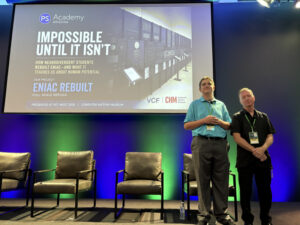
The project also earned an invitation to the Vintage Computer Festival at the Computer History Museum in Silicon Valley, where 15-year-old student Cameron Coleman and Burick presented the replica’s story to an audience familiar with computing history.
For a student, explaining a complex technical project before engineers, historians and technology enthusiasts represents a different kind of educational milestone.
It requires understanding the material, communicating effectively and recognizing that classroom work can contribute to conversations outside school.
Burick describes the significance of that experience:
“A young person’s trajectory can change the moment their internal story changes. If they have spent years believing they are less capable than everyone else, completing something this ambitious gives them a new story: ‘I built this. I understand this. I presented this to the world.’ That is extraordinarily powerful.”
A Lesson Worth Carrying Into 2027
National STEM Day encourages young people to explore science, technology, engineering and mathematics. But the ENIAC project illustrates an equally important consideration: how students are given opportunities to engage with those subjects.
Meaningful STEM education does not always require sophisticated equipment or expensive facilities. It requires thoughtful instruction, accessible learning opportunities and projects that allow students to apply their abilities to meaningful challenges.
For schools serving neurodivergent students, that approach can be particularly valuable when projects accommodate different learning styles while maintaining ambitious expectations.
The success of PS Academy Arizona’s ENIAC recreation does not mean every student will pursue an engineering career. It demonstrates something more immediate: students can develop confidence, practical skills and a stronger sense of possibility when given meaningful responsibilities and the support to fulfill them.
As educators look toward 2027, the experience offers a reminder that educational innovation is not measured solely by the technology introduced into classrooms.
Sometimes, it is measured by what students discover they are capable of creating.
And in Gilbert, Arizona, nearly 80 students demonstrated that 22,000 pieces of cardboard could become something much more significant than a replica of a historic computer.